Unlocking a Hidden Tax Advantage: How Soil Nutrient Depreciation Can Offset Farm Income
-

- April 27, 2026
Unlocking a Hidden Tax Advantage: How Soil Nutrient Depreciation Can Offset Farm Income
When most people evaluate farmland or grassland, they look at the obvious factors—yields, grazing capacity, water, and location. But there’s another layer of value that often goes unrecognized, yet can have a meaningful impact on the bottom line:
the nutrients in the soil—and how they depreciate over time.
Through its recent affiliation with Boa Safra Ag, Rocking X Land is helping landowners and investors better understand how soil fertility isn’t just an agronomic factor—it can also be a financial and tax-planning tool.
Soil Nutrients as a Depleting Asset
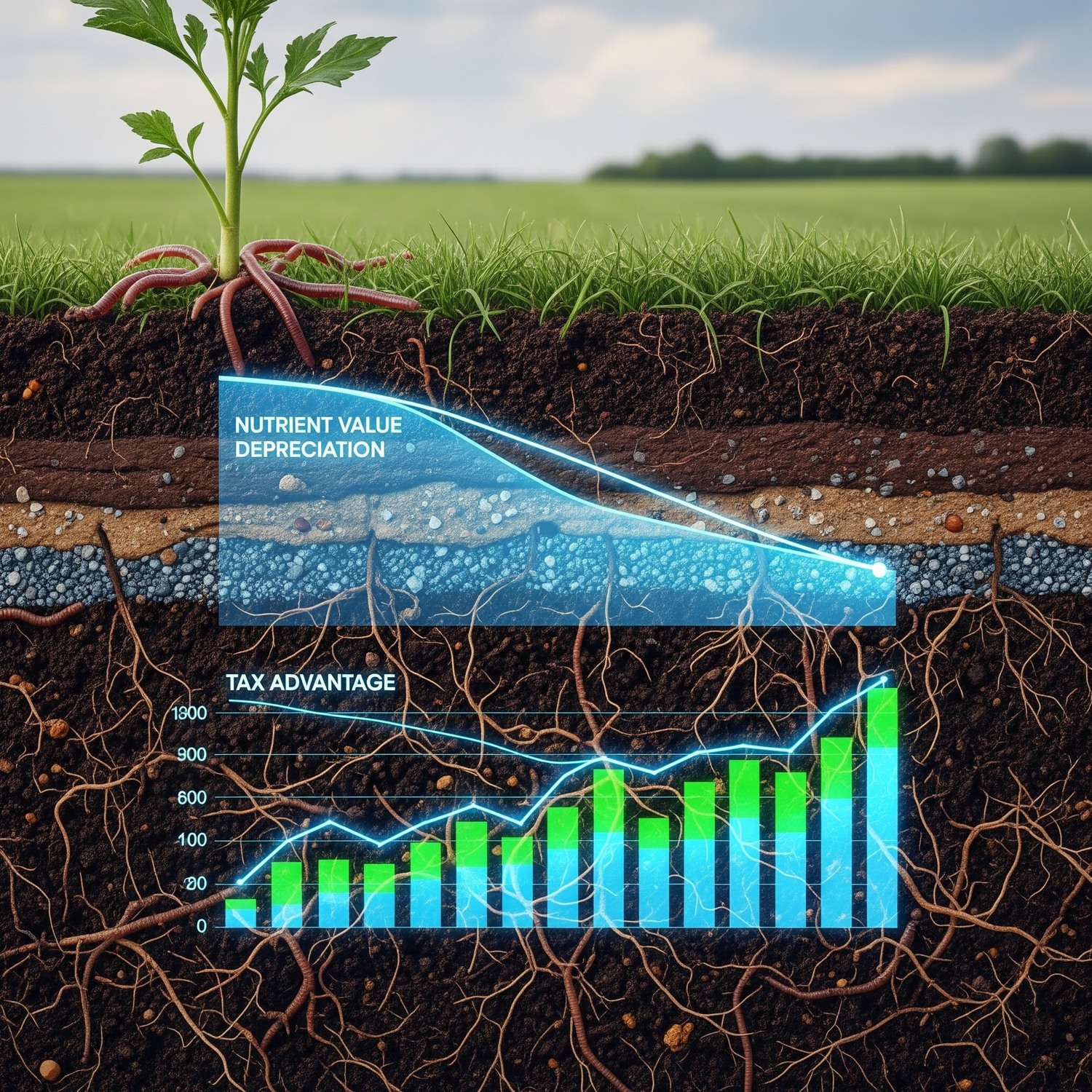
Every acre of farmland or grassland contains a measurable level of nutrients—nitrogen, phosphorus, potassium, and key micronutrients—that support production. Whether it’s row crops or native grass, those nutrients are gradually depleted through use.
- Crops remove nutrients with every harvest
- Livestock grazing draws down soil fertility over time
- Natural processes alone rarely replenish nutrients at the same rate
From a financial standpoint, this depletion represents something important: a consumable asset being used to generate income.
And in the right structure, that matters.
Where Depreciation Comes Into Play
When farmland is acquired, a portion of the purchase price can often be allocated to the existing nutrient levels in the soil—essentially recognizing fertility as part of the asset base.
As those nutrients are utilized over time, they may be eligible for depreciation or amortization, depending on how the asset is structured and documented.
This creates a unique opportunity:
The gradual depletion of soil nutrients can potentially be used to offset taxable income generated by the property.
For producers, that income might come from crop sales or grazing operations.
For investors, it may come from cash rent, lease income, or other agricultural returns.
Instead of viewing fertilizer strictly as an annual expense, this approach allows part of the existing fertility to be treated as a declining asset with tax implications.
Applies to Both Farmland and Grassland
This concept isn’t limited to high-production row crop farms.
Grassland and ranch properties—often overlooked in this conversation—also carry measurable nutrient value. Over time, grazing pressure reduces those nutrient levels, just as crop production does on farm ground.
That means:
- Ranchers may have an opportunity to account for nutrient depletion tied to grazing income
- Investors in pastureland may be able to offset lease revenue
- Mixed-use properties can benefit from both sides of the equation
In all cases, the key is establishing a credible baseline through soil analysis and properly structuring the allocation at the time of purchase.
A Strategic Tool—Not a Shortcut
It’s important to approach nutrient depreciation the right way.
This is not a one-size-fits-all strategy, and it requires coordination between:
- Soil analysis professionals
- Land brokers familiar with structuring these opportunities
- Qualified tax advisors who understand agricultural assets
When done correctly, however, it can become a meaningful part of a broader financial strategy—especially in years where income is strong and tax exposure is higher.
Why This Matters for Today’s Landowners
Margins in agriculture can be tight, and input costs continue to fluctuate. At the same time, farmland remains a highly sought-after asset for both producers and outside investors.
Being able to legitimately offset income tied to that land adds another layer of efficiency to ownership.
It’s not about changing how the land is used—it’s about better accounting for what’s already there.
And in many cases, that value has been sitting in the soil all along.
A Smarter Way to Look at Land
The affiliation between Rocking X Land and Boa Safra Ag is rooted in this idea: landowners should have access to strategies that go beyond the surface.
By identifying, measuring, and properly structuring soil nutrients as a depreciable component of the asset, producers and investors alike can:
- Improve after-tax returns
- Gain a more accurate understanding of land value
- Build more efficient, long-term ownership strategies
It’s a practical, data-driven approach that aligns with how modern agriculture—and land investment—is evolving.
Start the Conversation
If you own farmland or grassland, or are considering an acquisition, it may be worth taking a closer look at what’s beneath your feet—and how it factors into your financial picture.
Call Virgil George at 719-349-1966 to learn how nutrient depreciation and advanced land strategies could help offset income and strengthen your operation or investment.
Share this post
Virgil George began his real estate career in 2000 after growing up in the agricultural industry and working in both farming and agricultural equipment sales. In 2005, he founded Rocking X Land Company, Ltd., a brokerage focused on agricultural, ranch, recreational, and...